


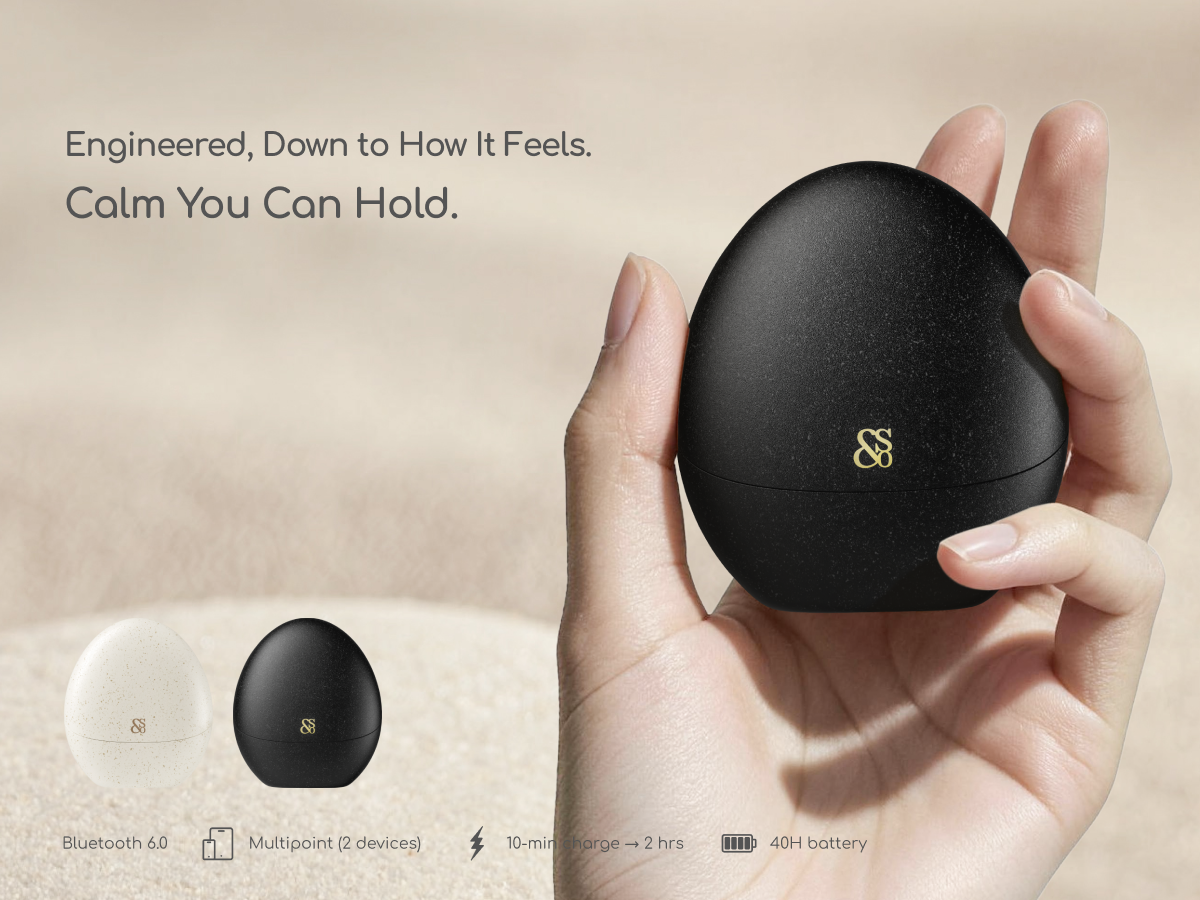
Music arriving from your phone and speech captured by your microphones travel along different audio paths. Inside a small pair of earbuds, both depend on coordinated processing, wireless communication and power management.
The AC7106D audio system-on-chip (SoC) is one of the core components in SoClip Pebble. It brings digital signal processing, Bluetooth, audio inputs and outputs, and power management together on one platform.
Here is what that chip does, how playback differs from microphone capture, and why a list of chip capabilities is not the same as a finished earbud’s feature list.
What does the AC7106D audio chip do?
A system-on-chip integrates several functions that work together. In SoClip Pebble, the AC7106D provides an engineering foundation for receiving wireless audio, processing signals, supporting microphone capture and managing power.
Its 4 × 4mm QFN32 package helps the engineering team arrange a compact circuit. The size of the finished earbuds still depends on the battery, driver, antenna and wearing structure—not the chip alone.
AC7106D specifications at a glance
The following figures summarize the chip information in S&O Labs’ technical brief, rather than measured performance of the complete earbuds.
| Component or capability | Specification | How to interpret it |
|---|---|---|
| Package | 4 × 4mm QFN32 | Chip-package dimensions, not earbud dimensions |
| Processing core | Single-core, 32-bit DSP; up to 192MHz | The processor architecture and maximum clock frequency |
| On-chip memory | 240KB SRAM | Shared working memory, not unused space reserved for extra algorithms |
| Audio output | One 24-bit differential DAC channel | Converts digital audio into an analog output for the playback path |
| Microphone inputs | Two 24-bit audio ADC channels | Converts analog microphone signals into digital audio |
| General-purpose ADC | 11-channel, 10-bit | A separate specification, not 11 additional audio-microphone inputs |
| Wireless and codecs | Bluetooth 6.0; SBC, AAC and LDAC support | Platform capabilities that work with the product’s implementation |
| Power functions | Integrated power and charging management | Part of the electrical design, not a standalone battery-life rating |
DSP and SRAM: processing sound takes both computing power and memory
The digital signal processor (DSP) handles continuous digital-audio work. The AC7106D uses a single 32-bit DSP core with a maximum clock frequency of 192MHz. Its 240KB of on-chip SRAM provides working space for tasks, audio buffers and algorithms.
That memory is not all freely available for additional processing. Wireless connections and the system itself also need resources. A total-memory figure therefore cannot tell you how much space remains for a new feature.
Calculation tools are not proof of a particular AI model
The chip supports floating-point, fast Fourier transform (FFT) and matrix operations. These are tools for analyzing frequency components, adjusting signals and implementing algorithms.
Their presence does not establish that a particular AI model is running. A claim about a model’s architecture or performance would need separate information about the actual implementation.
Playback and microphone capture follow different paths
Playback: from Bluetooth data to the driver
A simplified playback path is:
Bluetooth audio data → decoding and digital processing → DAC → driver → sound at your ear.
The digital-to-analog converter (DAC) converts processed digital audio into an analog signal for the speaker output path. AC7106D’s single 24-bit differential DAC channel provides the basis for the output in one earbud.
Each SoClip Pebble earbud uses one 10.8mm dual-magnet dynamic driver. The left and right earbuds then work together as the listening pair. The chip processes and converts the signal; the driver turns the electrical signal into sound.
For the role of codecs, tuning and the driver, read SoClip Pebble LDAC Explained: How Sound Quality Takes Shape.
Microphone capture: from your voice to digital audio
During a call, the input travels in the other direction:
Sound → analog microphones → audio ADCs → digital processing → outgoing call audio.
An analog-to-digital converter (ADC) turns the microphones’ analog signals into digital data. AC7106D has two 24-bit audio ADC channels. This aligns with SoClip Pebble’s two analog microphones in each earbud.
There are four microphones across the pair, but that does not mean one chip is simultaneously capturing four audio channels. Nor does the microphone count, by itself, establish how signals are shared between the earbuds.
Explore the call-processing design in SoClip Pebble Call Noise Reduction: Dual Mics & 4D ENC.
Why the 11-channel general-purpose ADC is a different specification
The datasheet summary also lists an 11-channel, 10-bit general-purpose ADC. It serves a different purpose from the two 24-bit audio ADC channels.
When reading the microphone specification, use the audio-input figure. Adding together every channel with “ADC” in its name would misrepresent the chip’s audio-capture configuration.
These signal paths are simplified explanations, not complete circuit diagrams or a disclosure of the earbuds’ internal signal-routing implementation.
Chip capabilities need hardware, firmware and tuning
ENC and ANC address different audio paths
AC7106D supports single- and dual-microphone ENC, as well as wideband digital adaptive ANC. Call ENC concerns the microphone audio sent to the person on the other end. ANC concerns environmental noise at the wearer’s ears.
SoClip Pebble uses ENC for calls, not ANC for listening. ENC helps reduce background noise in the microphone audio sent to the other caller. Chip-level ANC support does not mean that the finished earbuds provide active noise cancellation to the wearer.
Platform options are not an automatic list of available features
The platform capability list also includes spatial sound effects, hearing-assistance processing, Speak-to-Chat and wear detection. They describe possibilities for implementation, not a promise that every feature is available on SoClip Pebble.
Available functions should be confirmed against the product specification, firmware and actual app interface. A capability on a datasheet is not a substitute for a usable feature in the finished earbuds.
Features also need to work well together
Running several algorithms means considering processing resources, memory and power consumption together. A feature that can run on its own does not establish that every combination will perform well simultaneously.
Product tuning needs to examine whether transitions sound natural, playback remains stable and battery use changes. Those combined experiences matter more in everyday use than the length of a feature list.
Bluetooth, codecs and power management share the same platform
The AC7106D integrates Bluetooth 6.0 and charging management, alongside support for SBC, AAC and LDAC. This gives the engineering team a common platform for coordinating sound, wireless operation and the electrical design.
The chip does not make those experiences better automatically. The finished result depends on how the platform is implemented with the other components and software.
For specific connection behavior, read SoClip Pebble: Bluetooth 6.0, Multipoint & 100ms Game Mode. For charging and runtime conditions, see SoClip Pebble Battery Life: 12 Hours, 40 Hours & Fast Charging.
Frequently asked questions
Which audio chip does SoClip Pebble use?
The product configuration described in this guide uses the AC7106D audio SoC. It integrates digital signal processing, Bluetooth, audio conversion and power management.
Does a 32-bit DSP mean every audio specification is 32-bit?
No. The 32-bit figure describes the DSP architecture. The technical brief separately specifies a 24-bit DAC and two 24-bit audio ADC channels. Those figures describe different components, not one interchangeable sound-quality rating.
Are all AC7106D features enabled on SoClip Pebble?
Not every platform capability should be treated as an enabled product feature. Microphone design, firmware, app support and resource allocation determine how a capability is implemented. Check the feature information for the product version you use.
Technical basis
Product and chip details follow S&O Labs’ technical brief, which references the SoClip Pebble product specification and AC7106D Datasheet V1.4. This article explains the design; it is not a teardown or an independent performance test. Chip capabilities and maximum specifications should be distinguished from enabled features and measured results for the finished earbuds.
Explore the complete SoClip Pebble design
A chip specification is most useful when it helps you understand the product you will wear. With SoClip Pebble, consider the whole combination: how audio reaches your ears, how your voice is captured, how the controls behave and how the open-ear fit feels.
The AC7106D provides part of that foundation. The value of the finished earbuds comes from how the chip, drivers, microphones, power system and wearing structure work together.
Explore SoClip Pebble’s design and product details to decide how it fits your music, calls and everyday listening.
Share:
SoClip Pebble Battery Life: 12 Hours, 40 Hours & Fast Charging
SoClip Pebble Controls: Physical Buttons & SoLabs App