



Earbuds used every day have to deal with more than sound. They are exposed to sweat, occasional rain, repeated fitting, removal, charging and small adjustments throughout the day.
For SoClip Pebble, two durability specifications are particularly relevant: IPX5 water resistance for the earbuds and a stated 5,000-bend durability figure for the C-Bridge.
These numbers are useful only when their limits are clear. IPX5 does not make every part of the product equally water-resistant, and a bend-cycle figure is not a promise of unlimited flexing.
This guide explains what each specification applies to, how to care for the earbuds after moisture exposure, and how to think about structural durability in everyday use.
SoClip Pebble durability at a glance
| Area | Product information | What it means |
|---|---|---|
| Earbud water resistance | IPX5 | Applies to the earbuds, not automatically to the charging case |
| Charging case | No IP rating stated | Keep the case dry |
| C-Bridge durability | 5,000 bends | A structural durability figure, not a guaranteed number of wearing days |
| Earbud weight | Approx. 4.97g each | Part of the balance between lightness, fit and structure |
| Charging-case weight | Approx. 48g | Separate from the earbud durability rating |
| Main materials | ABS, PC, silicone, shape-memory titanium wire and aluminum-alloy buttons | Different materials serve different structural and contact roles |
IPX5 applies to the earbuds—not the whole product
SoClip Pebble’s IPX5 rating applies to the earbuds.
The charging case does not share that rating. Although the earbuds and case are sold and used together, water-resistance claims should stay attached to the part that was actually rated.
That distinction matters after exercise, in light rain or whenever moisture is involved.
If the earbuds become wet, check their surfaces before placing them back in the case. The case itself should be kept dry rather than treated as though it has the same protection as the earbuds.
IPX5 water resistance is not the same as unlimited waterproofing
A water-resistance rating should not be expanded into uses it was not designed to describe.
For SoClip Pebble, IPX5 should not be interpreted as permission for swimming, soaking, hot-water exposure or washing the earbuds under arbitrary conditions.
Daily moisture such as sweat or rain is different from immersion, high temperature, water pressure, soap, salt water or other liquids.
Use and cleaning should therefore follow the product instructions rather than assuming that one IP rating covers every kind of water exposure.
What should you do after sweat or rain?
A simple routine is more useful than trying to test the water rating yourself.
- Remove visible moisture. Wipe the exterior gently with a clean, dry cloth.
- Check the charging contacts. Make sure the contact areas are dry before charging.
- Keep the charging case dry. Do not use the earbud IPX5 rating as evidence that the case can handle the same moisture.
- Allow time to dry if necessary. If moisture remains around the charging area, wait before returning the earbuds to the case.
Charging introduces electrical contact, so moisture protection and charging conditions should be treated as separate issues.
For more on the charging system, read SoClip Pebble Battery Life: 12 Hours, 40 Hours & Fast Charging.
The C-Bridge handles repeated fitting and adjustment
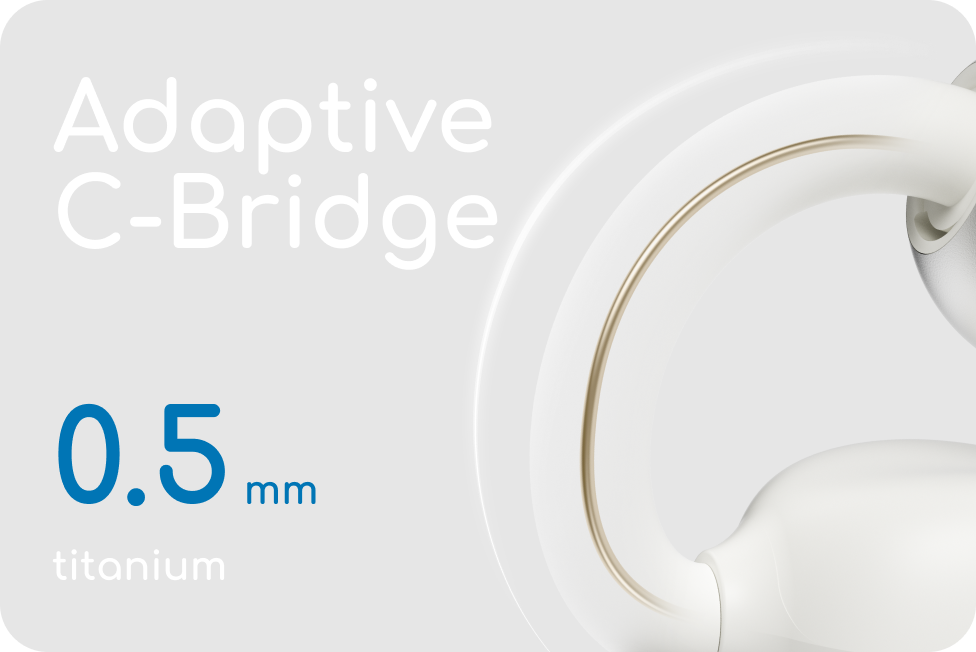
SoClip Pebble uses a C-Bridge structure with shape-memory titanium wire. The bridge connects the front and rear parts of the open-ear clip and provides the support that holds the earbud around the outer ear.
Unlike an in-ear tip, the design does not sit inside the ear canal. That means the C-Bridge plays a central role in fit and everyday handling.
Putting the earbuds on, taking them off and making small position adjustments all apply repeated force to this structure.
The stated durability figure is 5,000 bends.
What does “5,000 bends” actually mean?
A bend-cycle figure describes repeated structural loading under a defined test method.
It should not automatically be translated into:
- 5,000 days of use
- a guaranteed number of years
- unlimited twisting
- identical results for every bending angle or direction
The amount of force, bending angle, direction, speed and any previous damage can all affect the structure.
Because this article does not include the complete test procedure, it does not convert the 5,000-bend figure into a product-lifetime claim.
Durability testing is not an invitation to stress-test the earbuds
The C-Bridge is designed for everyday wearing and adjustment.
That does not mean users need to repeatedly pull, twist or overextend it to “check” the durability figure.
Put the earbuds on and remove them using normal, gentle movements. If the bridge becomes visibly deformed, unusually loose or uncomfortable, stop using it and inspect the product instead of continuing to bend it.
The purpose of durability engineering is to support normal use—not to turn the earbud into a stress toy.
For more on how the C-Bridge and open-ear structure work, read SoClip Pebble Open-Ear Clip-On Earbuds: Design, Sound and Fit.
Materials, weight and durability work together
The product specification lists several materials, including:
- ABS
- PC
- silicone
- shape-memory titanium wire
- aluminum-alloy buttons
Each material serves a different role in the housing, contact surfaces, bridge or controls.
A material name alone does not establish complete durability, comfort or skin compatibility. Those outcomes depend on where the material is used, how the product is constructed and how it interacts with the wearer.
If a contact area remains uncomfortable or irritated during use, remove the earbuds and check the fit rather than assuming that a material description guarantees comfort for everyone.
Lightweight design does not remove the need for structure
Each SoClip Pebble earbud weighs approximately 4.97g, while the charging case is approximately 48g.
Low weight can help reduce the amount of mass supported by the ear, but durability still requires a stable structure.
A useful product has to balance both:
light enough for everyday wear, while strong enough for repeated fitting, adjustment and transport.
The finished experience depends on that balance—not on weight or material strength in isolation.
Chip-level ratings are not whole-product durability ratings
The AC7106D datasheet includes electrical specifications relating to areas such as temperature and electrostatic conditions.
Those specifications apply to the chip under its own defined test conditions.
SoClip Pebble is a complete system that also includes:
- batteries
- microphones
- drivers
- charging contacts
- the C-Bridge
- housing materials
- circuit boards
- antennas
A chip-level test rating therefore should not be presented as evidence for the finished earbuds’ drop resistance, environmental resistance or electrostatic performance.
For an overview of what the AC7106D actually does inside the earbuds, see SoClip Pebble AC7106D Explained: The Chip Behind the Sound once published.
Certification lists and completed certifications are not the same thing
Product development often involves a list of required tests, certifications and compliance items.
Being listed as a project requirement does not mean that every certificate has already been issued.
For public product information, certification language should match the documentation that is actually available for the specific model.
The same principle applies to IP ratings: IPX5 should remain IPX5. It should not be upgraded to IPX6, described as fully waterproof, or generalized to the charging case without supporting evidence.
Clear limits are more useful than a longer list of claims.
A practical everyday-care checklist
You do not need a complicated maintenance routine.
For normal use:
- Keep the charging case dry.
- Wipe sweat or rain from the earbuds before charging.
- Make sure charging contacts are clean and dry.
- Put on and remove the C-Bridge with normal, controlled movement.
- Avoid unnecessary twisting or extreme bending.
- Stop and inspect the product if you notice deformation, unusual looseness or damage.
- Follow the current product guide for cleaning and charging.
These habits do not change the product’s rated durability. They simply keep everyday use within the conditions the design is intended to handle.
Frequently asked questions
Is SoClip Pebble waterproof?
The earbuds are rated IPX5. It is more accurate to describe them as water-resistant within that rating rather than as universally waterproof.
Does the charging case have an IPX5 rating?
No IP rating is stated for the charging case. Keep it dry and do not extend the earbud rating to the case.
Can I swim with SoClip Pebble?
The IPX5 rating should not be interpreted as an immersion or swimming rating. This article does not recommend swimming or submerging the earbuds.
Can I put the earbuds back in the case when they are wet?
Remove visible moisture and make sure the charging-contact areas are dry first. The case itself has no stated IP rating.
What does the 5,000-bend figure mean?
It is a durability figure for the C-Bridge under a test method. Without the complete test conditions, it should not be converted into a guaranteed number of days or years of use.
Does 5,000 bends mean I can twist the C-Bridge freely?
No. The structure is designed for normal fitting and adjustment. Repeated extreme twisting is not a recommended way to use or test the product.
Technical basis
Product-specific information in this guide follows S&O Labs’ product brief, including the confirmed IPX5 earbud rating and 5,000-bend C-Bridge durability figure.
IEC 60529 is the international standard covering IP-code classifications for electrical enclosures. IEC Webstore
This article explains how to interpret the product specifications. It is not an independent ingress-protection test or structural-lifetime test, and it does not expand the stated ratings beyond the information available for SoClip Pebble.
Reliability works best when the limits are clear
SoClip Pebble’s durability story does not need exaggerated language.
The earbuds have a defined IPX5 water-resistance rating. The charging case should stay dry. The C-Bridge has a stated 5,000-bend durability figure, but that number is not an invitation to over-stress the structure.
Understanding those limits makes the product easier to use with realistic expectations.
Share:
SoClip Pebble Controls: Physical Buttons & SoLabs App
SoClip Pebble 5-Minute Reset: Open-Ear Listening for Everyday Pauses